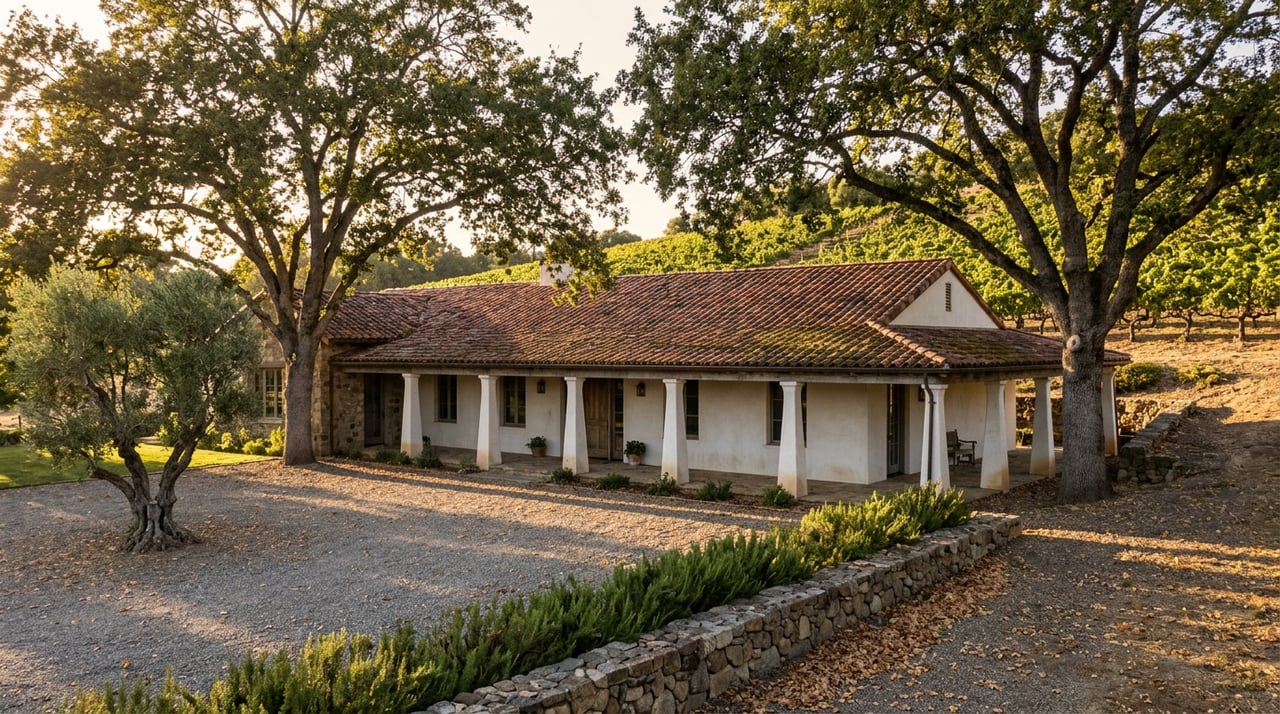
A framed newspaper page hangs on a wall inside Dry Creek Vineyard's tasting room. The headline, from an April 1973 edition of the Press Democrat, reads "Winery Planned Near Healdsburg." The story describes a groundbreaking where a 10-year-old girl named Kim Stare turned the first shovel of dirt for her father's new winery. Fifty-three years later, that girl runs the place. When Dry Creek Vineyard broke ground, only two wineries operated in the entire valley, and both were making bulk wine. Today there are somewhere around 65.
That span, from two bulk producers to a valley of family labels, is the backdrop against which every current headline about Sonoma grape prices should be read. And this year's headline is not a good one. If you're comparing Dry Creek Valley to other Sonoma neighborhoods and trying to figure out what a falling grape market means for the dirt under those vines, the honest answer is: less than you'd think, and for reasons that have nothing to do with this year's harvest.
What the crush report actually says
Every March, the California Department of Food and Agriculture releases the Grape Crush Report, and every March the wine trade press treats it as a referendum on the health of the industry. The 2025 preliminary report, released March 13, 2026, was not kind. Sonoma County's district-wide weighted average price came in at $2,761 a ton, down 5.7 percent from 2024's $2,927 and down again from $2,975 in 2023. That's the second straight year of decline. Tonnage fell even harder: Sonoma growers crushed 185,500 tons in 2025, down 13.5 percent from the year before, and the total value of the North Coast crop dropped 13 percent to $1.33 billion.
Part of the pressure is a straightforward glut. Grape broker Ciatti Co. estimated roughly 38 million gallons of bulk wine sitting on the California market as of early 2026, a level close to recent highs, and much of that inventory is aging vintages that get harder to sell the longer they sit. Turrentine Brokerage's Christian Klier added a detail worth sitting with: district averages reflect multi-year contracts negotiated well before this downturn, so the published number lags the price a grower would actually get on a new contract signed today. He estimated it could take another two years before the district average catches up to what's really happening in the market.
None of that is in dispute. What's worth questioning is the assumption that follows it automatically: that a soft grape market means soft vineyard land. That assumption holds in a district where land is bought to be farmed for tonnage and sold to the highest commodity bidder. It holds much less well in a valley where most of the best-known parcels have not changed hands in decades and were never for sale to begin with.
The land that isn't for sale
Dry Creek Valley's origin as a wine region is a story of families who never left. Pedroncelli Winery has been run by descendants of Giovanni and Julia Pedroncelli since they bought the hillside property west of Geyserville in 1927, and it's now in its third and fourth generation. The Proctor family has grown Zinfandel continuously on the same ground since 1904, farming it by mule until 1968, the year the last mule in the valley died and was finally replaced by a tractor. Neither of those facts has anything to do with this year's ton price. They have everything to do with why so little Dry Creek acreage ever reaches a listing agent.
The counterexample is instructive precisely because it's rare. Charles Dunz built the valley's first sizable winery in 1885 and sold it five years later to Andrew Frei, whose sons built Frei Brothers into one of only seven Dry Creek wineries to survive Prohibition. The family sold grapes to E&J Gallo for decades before Gallo bought the Frei Ranch outright in the late 1970s, telling the Press Democrat at the time that the benchland was incomparable for growing red wine. That sale is now closing in on fifty years old, and it remains one of the handful of stories locals still tell when a big buyer approaches a family vineyard. It's the exception that proves how unusual a full sale is here.
Kim Stare Wallace, Dry Creek Vineyard's second-generation president, has been explicit about resisting the industry's broader consolidation. Under her, the winery cut production from well over 200,000 cases down to roughly 100,000, deliberately narrowing its footprint to focus on Dry Creek Valley fruit rather than county-wide sourcing, and she brought in a professional board that includes non-family members specifically to manage the generational handoff without the friction that breaks up so many family wineries. That's a governance decision, not a grape-pricing decision, and it's the kind of decision that keeps land off the market regardless of what the crush report says.
Why the per-acre numbers don't agree with each other
If you go looking for a single Dry Creek Valley price-per-acre figure, you'll find one that doesn't hold together, and that disagreement is itself the evidence for what's really happening.
| Land type | Reported price per acre | What actually explains the number |
|---|---|---|
| Raw land, no vines planted | $15,000 to $35,000 | Cost of irrigation, erosion control, and site prep before any income exists |
| Producing vineyard, standard clones and rootstock | $50,000 to $100,000-plus | Yield history, proven water source, existing buyer contracts |
| Producing vineyard, old-vine or heritage block | Reported as high as $100,000 to $180,000-plus | Vine age, dry-farmed status, and the fact that no amount of capital can replant a hundred-year-old block |
A raw-land buyer is pricing infrastructure. A buyer of a standard producing vineyard is pricing yield and water reliability. A buyer of a heritage block like Beeson Ranch, the old-vine parcel Dry Creek Vineyard has farmed under a decades-long partnership, or Lytton Springs, planted in the late 1880s and folded into Ridge Vineyards' estate holdings in 1991, is pricing something the grape market can't touch: vines that took a century to become what they are and cannot be shortcut by planting new stock next year. That premium doesn't move with an annual ton price. It moves with how many of those blocks exist, and the honest answer is very few, and fewer every year that none of them sell.
What Williamson Act contracts quietly do to supply
Land use policy reinforces the same scarcity. Sonoma County Williamson Act contracts reduce property taxes on agricultural land, but they come with real constraints. A Type I contract, covering prime permanent-crop land, generally requires a minimum of 10 acres and specific planting thresholds. A Type II contract, for non-prime land, generally requires at least 40 acres. Contracts renew automatically on a rolling 10-year basis unless a Notice of Non-Renewal is formally recorded, which means a huge share of Dry Creek Valley acreage is locked into agricultural use by default, not by any single owner's annual decision. That's one more reason supply here doesn't respond quickly to a bad crush report. The land can't easily flip to a different use even if an owner wanted it to.
What this means if you're buying or selling here
If you're evaluating a Dry Creek Valley parcel this year, the crush report is not where the real signal lives. Before treating any grape price headline as relevant to a specific property, check instead:
- Vine age and whether the block predates the standard trellis systems used on newer plantings
- How long the current owner or family has held the land, and whether it has ever changed hands
- Williamson Act status, contract type, and whether a Notice of Non-Renewal is on file
- Water source, since a proven well or documented surface right supports a different valuation than a parcel still dependent on trucked water
A falling district-wide grape price tells you something true about this year's bulk market. It tells you almost nothing about what a family that's held the same 40 acres since before Prohibition will accept for it next year, or the year after that.
FAQ
Does the countywide grape price decline mean Dry Creek Valley vineyard prices will fall too? Not on the same timeline. Grape pricing reflects annual contracts and current supply. Land value in Dry Creek Valley reflects vine age, ownership tenure, and entitlement status, factors that don't reset every harvest.
What counts as an "old vine" vineyard in Dry Creek Valley? There's no legal definition. The industry convention treats vines averaging 50 years or older as old vine, though Dry Creek Vineyard was the first to use the term commercially, starting with its 1987 vintage, and some of the valley's most cited blocks, including Beeson Ranch and Lytton Springs, exceed a century in age.
Does a Williamson Act contract help or hurt me as a buyer? It can lower your property tax bill, but it locks the parcel into agricultural use on a rolling 10-year term unless a Notice of Non-Renewal has already been recorded. Confirm the contract type and its status on title before assuming any flexibility to change how the land is used.
Dry Creek Valley rewards the kind of buyer or seller who reads past the headline number. If you're weighing a heritage parcel against its per-acre price, or trying to value land that's never once appeared on a market report, Graham Sarasy can walk through the ownership history, water rights, and entitlement status that actually set the price. Request a confidential consultation to start that conversation.