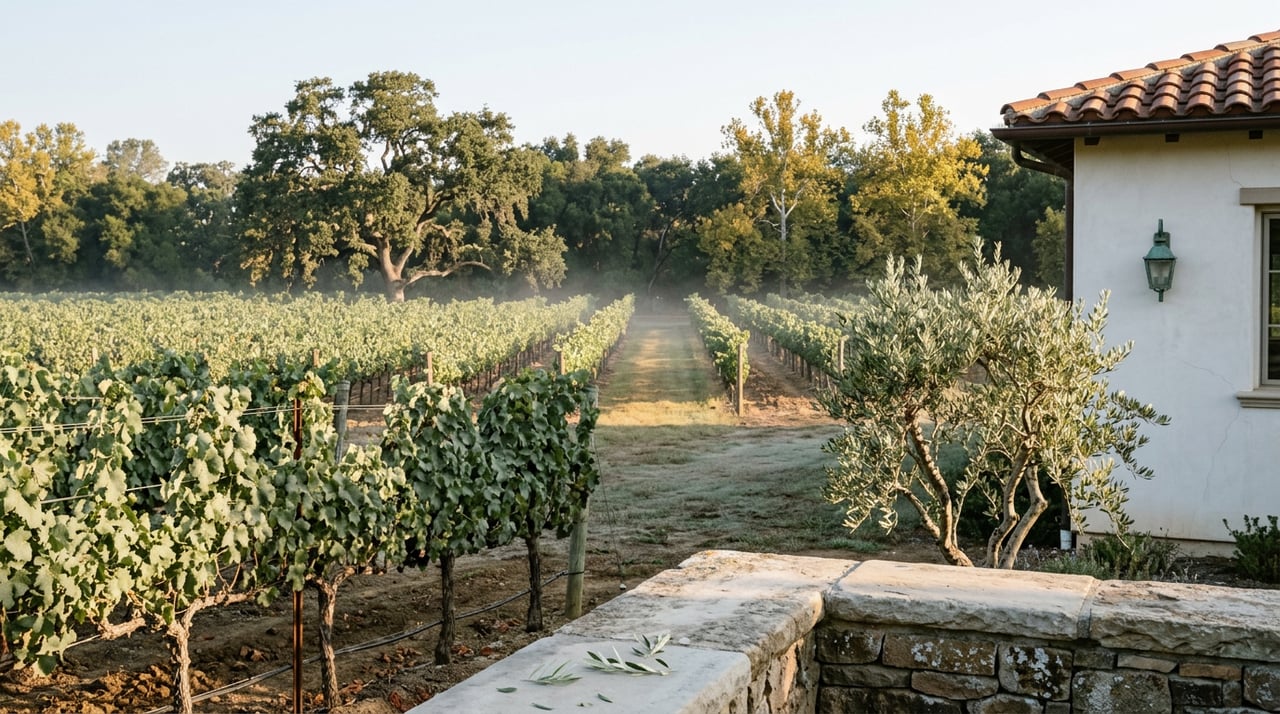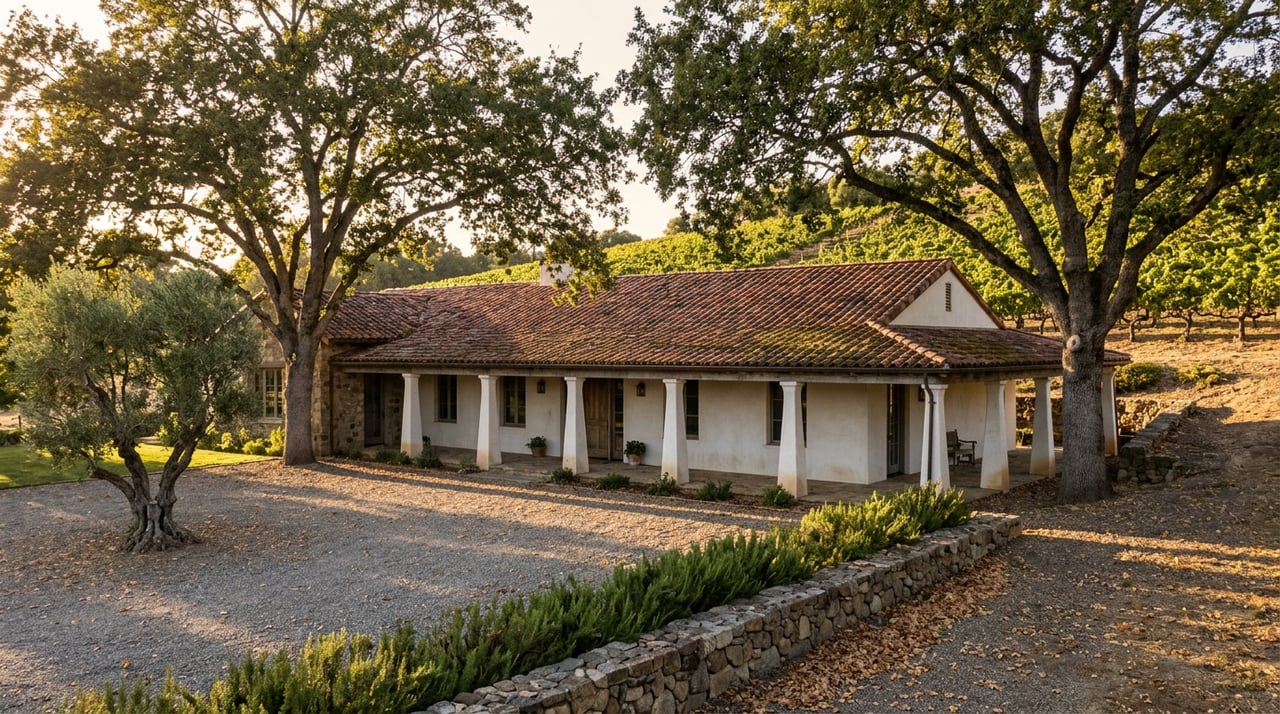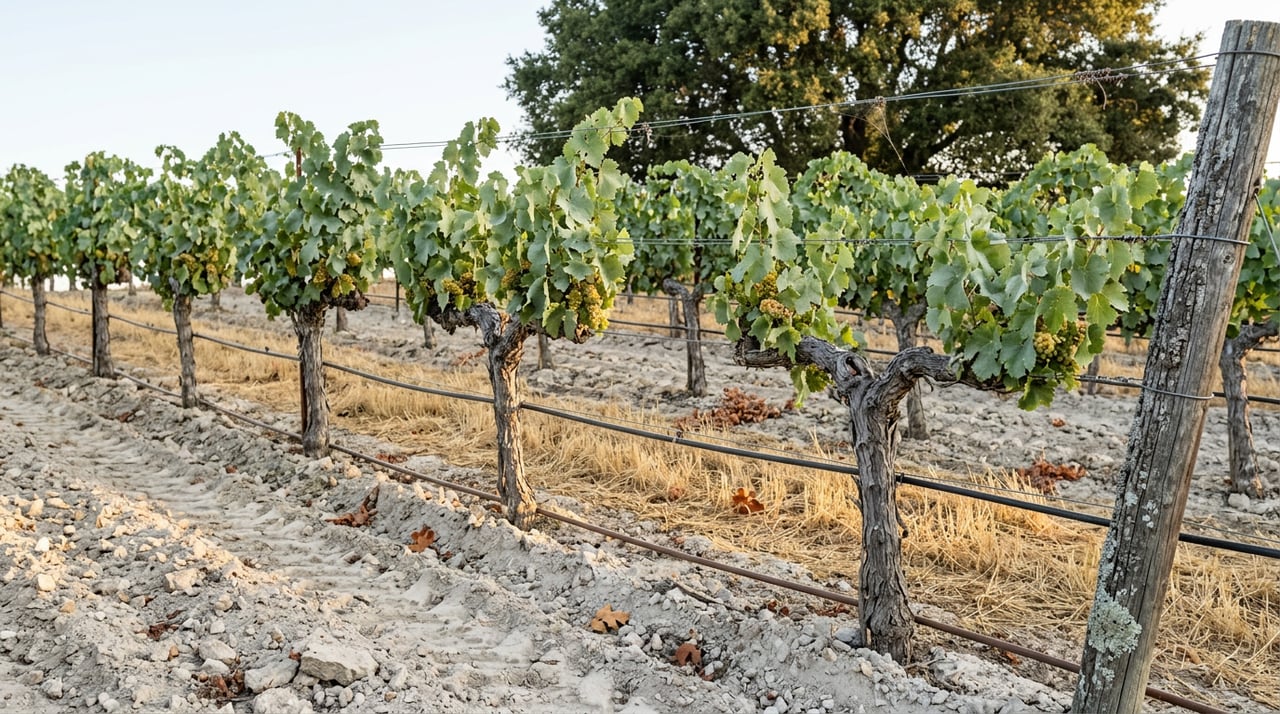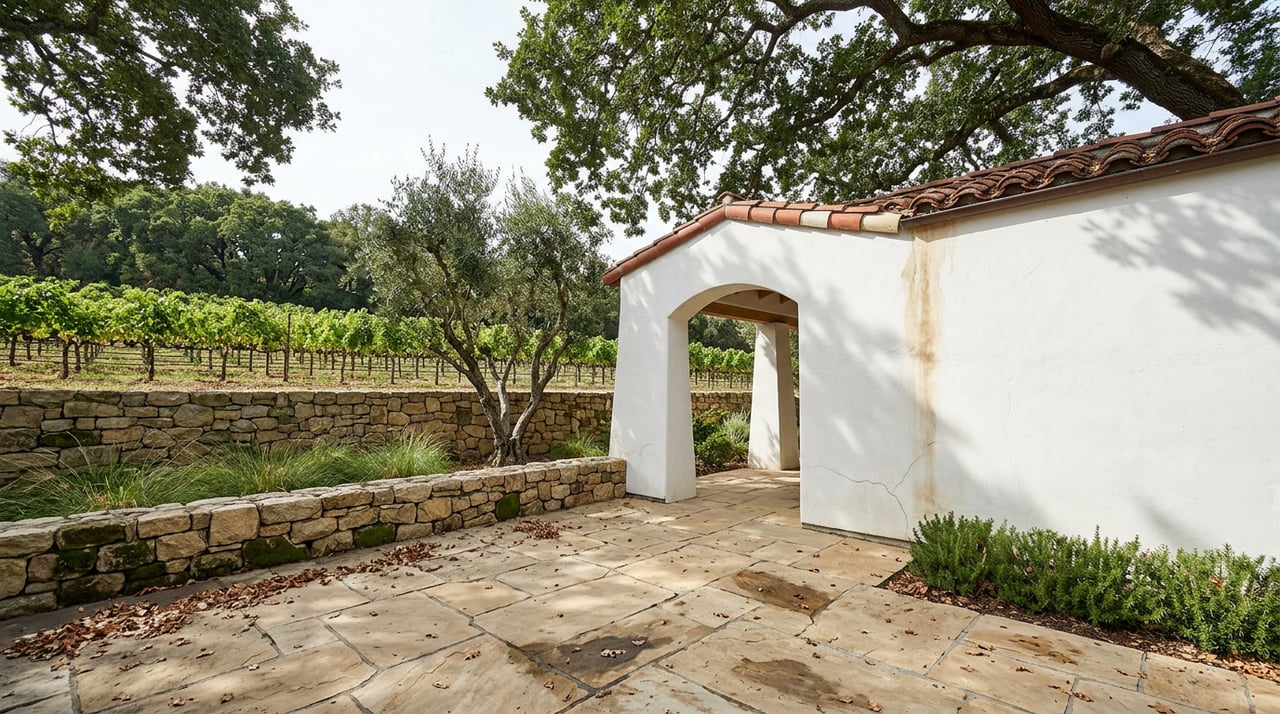
Forty acres on Chalk Hill Road went on the market this year with a view that stretches from Mt. St. Helena to Geyser Peak, an asking price of $895,000, and one sentence in the listing that tells you almost everything about buying rural land in this appellation: the parcel previously had a five-bedroom perc test and vesting, and both have expired.
That is the whole story in miniature. Somebody once did the work to prove this ground could support a house. The county signed off. Then enough time passed that the approval lapsed, and the next owner has to start over. Nothing about the soil changed. The paperwork did.
Chalk Hill sells on scenery and story, hillside vineyards, chalky volcanic soil, the AVA line that runs through three appellations at once. What actually governs a transaction here is a set of county maps and permit rules that have nothing to do with any of that, and two parcels that look identical from the road can sit on opposite sides of a permitting line that was drawn from a 1980 geology study.
Four addresses, four different realities
Recent activity on Chalk Hill Road shows the spread. A 2023-built modern farmhouse at 9110 Chalk Hill Road closed at $6.5 million in April 2026. A 1,976-square-foot house built in 1972 at 14856 Chalk Hill Road, sitting on 1.8 acres, changed hands in May 2026 for $1.33 million, or $671 per square foot, according to Press Democrat's home sales report. Bell Mountain Ranch, at 13414 Chalk Hill Road, came to market in May 2026 at $15.5 million, a Regenerative Organic Certified vineyard estate sitting at the point where the Alexander Valley, Russian River Valley, and Chalk Hill AVAs meet, with three ponds and its own solar infrastructure. And then there is the bare 40-acre parcel at 11005 Chalk Hill Road, listed by Eric W. Drew of Healdsburg Sotheby's International Realty at $895,000, carrying that lapsed perc test and expired vesting.
Four addresses on the same road. Four completely different levels of infrastructure risk. Price tells you nothing about which bucket a given parcel falls into. Only the permit history does.
The map making the actual decision
Sonoma County classifies every parcel into one of four groundwater availability zones based on water yield and recharge conditions. The dataset behind that map comes from a 1980 surface geology study and the county's 1989 general plan, and the county's own documentation says the map "is not suitable for parcel-specific decision making." Site-specific studies are what actually settle the question.
That disclaimer matters more than it sounds like it should. Until a hydrogeologic report or an official Letter of Map Amendment changes the record, the illustrative map is still what Permit Sonoma staff use to decide how your well permit gets processed. And when a parcel straddles the line between two zones, county policy is to default to the more restrictive one unless the applicant brings strong evidence otherwise.
Class 4 areas, defined as low or highly variable water yield, require a test well before the county will confirm an adequate water supply. Class 3 areas may require the same if a hydrogeologic report recommends it. Chalk Hill's terrain, chalky and volcanic, is exactly the kind of geology that tends to produce marginal and highly variable yield, which is why test wells and hydrogeologic reports show up more often in this appellation than they do in flatter parts of the valley floor. None of that means every Chalk Hill parcel carries the same classification. It means nobody should assume their neighbor's well performance says anything about their own, and the only way to know for certain is to pull the parcel's specific record before listing or making an offer.
What changed on your well permit in 2023
Sonoma County's Board of Supervisors amended the well ordinance effective May 18, 2023, adding a Public Trust Analysis to the permitting process. Under the current rules, dry weather well testing is required when building a new or replacement dwelling in a Class 4 area, when adding an accessory dwelling unit in a Class 3 or 4 area, or whenever Permit Sonoma staff require it to satisfy health and safety conditions.
The same amendment created a Public Trust Review Area. Inside that area, a well that would push total groundwater use on the parcel above two acre-feet per year triggers discretionary review, water conservation planning, and limits on vineyard and orchard irrigation. Outside residential use under that threshold, the county has been clear that no new meters are required on existing wells or on new wells serving ordinary household use. Meters come into play mainly for wells serving non-residential or mixed-use parcels, which matters directly for anyone buying a Chalk Hill property with an active tasting room, event space, or commercial vineyard operation attached.
The septic rulebook just got rewritten too
While the well ordinance was settling, the county's septic framework went through its own multi-year rewrite. The Board of Supervisors approved and submitted an updated Local Area Management Program and Onsite Wastewater Treatment System Manual, version 8.0, to the North Coast Regional Water Quality Control Board in August 2024. The Regional Board sent back comments in March 2025. The county responded with a revised version 9.0 in December 2025. In June 2026, the Regional Board approved the Sonoma County LAMP and OWTS Manual through Resolution No. R1-2026-0022, closing out a process that took nearly two years.
One practical result of the broader policy shift, which the county dates to 2023, is that only septic systems using supplemental treatment now have to stay enrolled in the county's Operational Permit and Monitoring program. Roughly 3,000 systems have graduated out and no longer owe biannual self-monitoring forms or annual fees. About 1,150 systems, the ones with supplemental treatment components, remain under active county inspection.
If a Chalk Hill property carries one of those remaining systems, there is very likely a recorded easement on title that lets county staff onto the property to inspect it, and that easement transfers to whoever buys the property next, unless the seller has already filed a quit claim request to remove it. Permit Sonoma's own description of the county's terrain explains why any of this matters here: the department has said plainly that "Sonoma County's soils are notoriously poor for septic systems," which is exactly why supplemental treatment units and OPR enrollment show up more often on hillside parcels like the ones lining Chalk Hill Road than they do on the valley floor.
What this means if you are listing or buying this fall
The work that actually protects a Chalk Hill transaction happens before the property hits the market, not during escrow.
- Pull the parcel's groundwater availability class and permit history before setting a listing price, rather than assuming the AVA's reputation for good vineyard water tells you anything about a specific well.
- If new construction or an ADU is part of the plan, check now whether the parcel sits in a Class 3 or 4 area, since dry weather testing there can add weeks to a permit timeline.
- Confirm whether an existing septic system is enrolled in the county's Operational Permit program, and if so, whether the recorded easement is something a buyer will inherit or something a seller can clear first.
- Treat an expired perc test or lapsed vesting the way the 11005 Chalk Hill Road listing does, as a known cost to disclose and price around, not a surprise to discover at inspection.
- When a parcel sits on a boundary between two groundwater classes, expect the county to apply the more restrictive one unless a hydrogeologic report or Letter of Map Amendment says otherwise.
FAQ
Does a strong AVA reputation guarantee good well yield on a specific parcel? No. The county's groundwater classification map is drawn from decades-old regional geology data and applies zone by zone, not parcel by parcel. Two neighboring properties in the same AVA can carry different classifications.
Can a property's groundwater classification be changed? Yes, through an official Letter of Map Amendment process, or through a site-specific hydrogeologic report submitted with a permit application. Until either happens, the county continues to use the existing illustrative map for permitting decisions.
What happens to a septic Operational Permit easement when a property sells? Valid Operational Permits are transferable to the new owner. The recorded easement allowing county inspection stays in place unless the seller has already completed a quit claim request to have it removed.
Chalk Hill rewards buyers and sellers who do the infrastructure homework before it becomes a contingency. If you are weighing a listing or an offer on Chalk Hill Road or anywhere else in this appellation, Graham Sarasy can walk through what a specific parcel's well and septic history actually means for your timeline. Request a confidential consultation to start there.