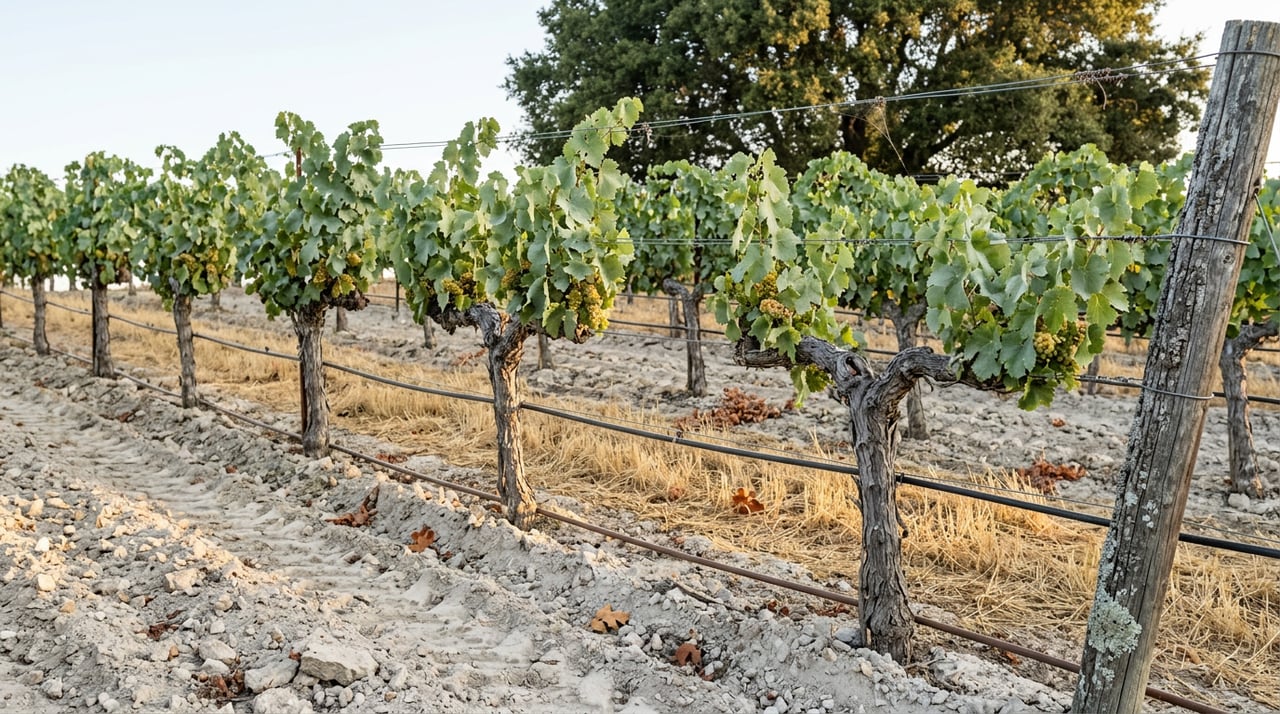
The Press Democrat reported that Tony Correia said, "It's like catching a falling knife. The market's moving faster than the appraiser does."
At an AWG Wine Advisors conference in Santa Rosa this past May, Tony Correia, a Sonoma-based agricultural land appraiser, was describing what's happening to vineyard values across Mendocino, Lake, Sonoma and Napa counties right now, and the picture he painted was not subtle. Too many sellers. Too few buyers. Lenders tightening. Prices dropping faster than anyone can formally assess them.
If you own vineyard acreage in Chalk Hill, or you're circling a listing there, that quote should get your attention. It should also make you ask a harder question than most headlines invite: does this describe the appellation you're actually looking at, or does it describe a different Sonoma altogether?
The honest answer is both, and the difference matters enormously for how you read a comp, a price, or an appraisal in this specific pocket of Sonoma County.
The Number That Doesn't Match the Warning
Here's the contradiction that should stop any careful buyer or seller before they accept a headline at face value. In the same window Correia was warning of a collapsing vineyard market, Sonoma County's own property assessment roll hit a record high, $131.7 billion as of January 1, 2026, according to the County Assessor's July 2026 report. That's roughly a 4 percent increase over the prior year.
A record countywide roll and a falling knife in vineyard land are not actually in conflict. They're describing two different things layered on top of each other. The assessment roll blends every parcel in the county, residential subdivisions in Santa Rosa, commercial buildings in Petaluma, industrial land near the airport, alongside agricultural acreage. Residential and commercial values pulled the total up. Vineyard and orchard values, tracked separately within that same roll, moved the other way. The Assessor's office has been explicit about this: agricultural land under Williamson Act contracts received an added risk component in 2026 specifically to account for declining grape income, which lowered assessments on many ag parcels even as the county total climbed.
So the countywide number tells you almost nothing about what's happening to a specific vineyard parcel in Chalk Hill. You have to go one level deeper.
Two Sonomas, Not One
The deeper layer is where Correia's comments get genuinely useful. The Press Democrat reported that he didn't describe Sonoma's vineyard slump as uniform. He specifically pointed to investment funds that expanded plantings into cheaper "secondary areas" of the county during the boom years, and said those operations are now under significant strain. Grape demand across the county, he added, remains "a crapshoot."
That framing draws a line most countywide reporting skips. It separates commodity acreage, planted where land was cheap and available, from small, historically defined appellations where planting was never a volume play to begin with. Chalk Hill sits firmly on the second side of that line, and its own numbers explain why.
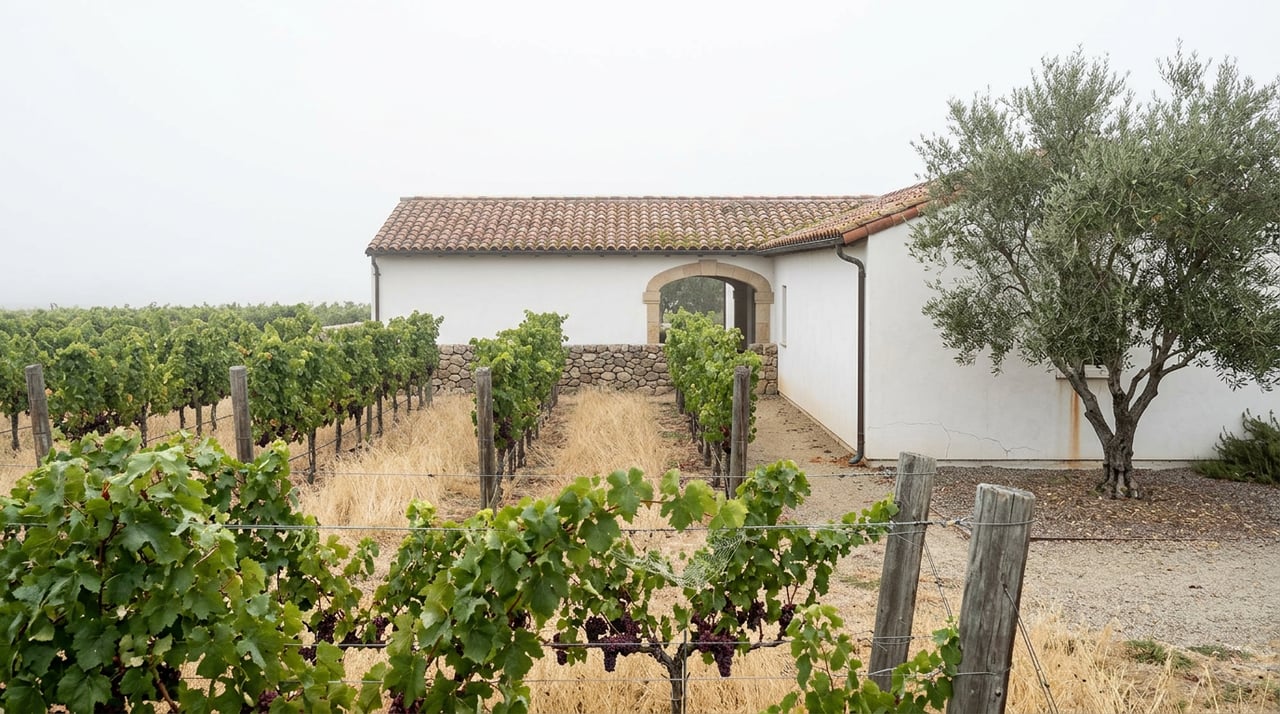
The Chalk Hill AVA covers roughly 21,120 acres total, but only about 1,600 of those acres are actually planted to vine, and just five wineries operate within its boundary. Compare that to the much larger Russian River Valley or Alexander Valley next door, both of which had far more room to expand acreage when capital was chasing yield. Chalk Hill never had that room. Its soils saw to that.
What the Grape Numbers Actually Show
The 2025 California Grape Crush Report, released in preliminary form in early 2026, gives a varietal-by-varietal look at how much ground Sonoma's grape economy actually lost, and it's not uniform either. Sonoma's countywide weighted average price fell to $2,761 per ton in 2025, down from $2,927 in 2024 and $2,975 in 2023, a two-year decline of roughly 7 percent. But that average hides real divergence by varietal:
| Varietal | 2023 ($/ton) | 2025 ($/ton) | Two-year change |
|---|---|---|---|
| Pinot Noir | $3,881 | $3,818 | -1.6% |
| Chardonnay | $2,560 | $2,429 | -5.1% |
| Sauvignon Blanc | $2,054 | $1,904 | -7.3% |
| Cabernet Sauvignon | $3,061 | $2,773 | -9.4% |
Cabernet took the steepest hit, shedding nearly $289 a ton over two years. Sauvignon Blanc wasn't far behind, a decline that likely reflects oversupply pressure from lower-cost districts planting into that variety. Pinot Noir barely moved, propped up by demand for Russian River Valley and Sonoma Coast fruit. Chardonnay sits in between, down but nowhere near as sharply as the reds and whites tied to expansion-era plantings.
That middle position matters, because Chardonnay is Chalk Hill's identity, not an afterthought.
Why Chalk Hill Was Never Built to Overexpand
Chalk Hill's defining feature isn't its size. It's its soil. The AVA sits on a layer of chalky white volcanic tuff, deposited by ancient activity from Mount Saint Helena, that is naturally low in fertility. That poor fertility isn't a flaw growers work around, it's the reason the fruit is prized. Restricted vigor concentrates flavor, and it also caps yields at roughly 2 to 3 tons per acre, well below what more fertile valley-floor alluvial soils can support elsewhere in the county.
That ceiling on yield is also a ceiling on how much anyone could ever overplant here. The name "Chalk Hill" first appeared on a wine label as far back as 1978, five years before the AVA was formally established in 1983, and Rodney Strong Vineyards has remained one of the appellation's defining producers ever since. Chalk Hill Estate is the only 100 percent estate winery within the appellation's boundary, farming its own fruit on its own ground rather than buying in bulk. Smaller operators like Notre Vue Estate, Windsor Oaks Vineyards, Trinité Estate and Calluna Vineyards round out the AVA's footprint. None of that reads like a district built for volume expansion. It reads like a district that stayed small because the land itself never allowed anything else.
That's the structural argument for why Chalk Hill functions closer to the "prime" side of Correia's split than the "secondary" side, even though it doesn't carry Napa's name recognition. It was never positioned to become the kind of overplanted acreage that's now getting sold at distressed prices to cover debt.
None of this makes Chalk Hill immune. The Press Democrat reported that Correia was equally blunt about Napa's luxury Cabernet tier, breaking even that supposedly bulletproof category into rough thirds: a third struggling outright, a third treading water, and the remainder holding value. Quality and scarcity reduce risk. They don't eliminate it.
The Question to Ask Before You Trust Any Comp
Here's where this becomes a practical transaction issue rather than an industry trend piece. If you're selling vineyard acreage in Chalk Hill and an appraiser or a prospective buyer's advisor comes back with a number that reflects the broader Sonoma correction, ask where the comparable sales are actually located. A comp drawn from overplanted acreage in a lower-cost district is not describing your five-winery, yield-capped appellation, even if it's filed under the same county.
The same logic runs in reverse for buyers. If a seller is anchoring their price expectation to what Chalk Hill fruit fetched in 2023, before the two-year slide in the table above, that expectation needs to be tested against the same varietal data, not dismissed outright, but checked against actual Chardonnay pricing trends rather than the countywide average.
And if you hold Williamson Act acreage in Chalk Hill, it's worth understanding that your 2026 assessed value may have already moved lower under the county's added risk adjustment for declining grape income, independent of what the countywide roll is doing. That's a separate line item from market value, but the two are easy to conflate if you're only looking at the headline number on your tax bill.
Is Chalk Hill vineyard land actually appreciating right now? The honest answer, based on what's available, is that it's likely losing less value than commodity Sonoma acreage rather than gaining outright. Nothing in the current data supports a claim that Chalk Hill is rising while the rest of the county falls.
Does this analysis apply to a Chalk Hill home purchase that isn't tied to vineyard production? Not directly. The mechanisms described here are specific to agricultural land valuation and grape economics. A residential parcel with a few acres of vines attached should still be evaluated on its own terms, with the vineyard component treated as one input among several.
If you're weighing a sale, an acquisition, or simply trying to make sense of an appraisal that doesn't match what you expected in Chalk Hill, this is exactly the kind of terrain where a broad market headline can mislead you. Graham Sarasy works this appellation and its neighbors directly, and can walk through what your specific parcel's comps actually look like. Request a confidential consultation before you price against a number that was never describing your land in the first place.
This article is general information, not legal, tax or financial advice. Consult a qualified professional about your situation.